
Welcome to RAC’s Weekly Traffic Dashboard. On this page you’ll find information on the latest rail traffic trends, including a breakdown by commodity: grain & fertilizers (incl. potash); intermodal; forest products; automotive; coal; metals and minerals; and energy, chemicals and plastics.
New data released every Tuesday – stay up to date with an email subscription.
Canadian Class 1 Freight Traffic
Last updated on September 22, 2026
In week 36 of 2026 (September 6 – September 12), Canadian Class 1 (CN and CPKC) network-wide carloads decreased by 3% and revenue ton-miles (RTMs) decreased by 5% compared to the same week in 2025. Across their North American networks, carloads increased for grains & fertilizers; and metals and minerals, while decreasing for intermodal; coal; automotive; energy, chemicals and plastics; and forest products. RTMs of metals and minerals increased, while decreasing in energy, chemicals and plastics; intermodal; coal; forest products; and automotive. RTMs of grain & fertilizers were flat.
Across the first 36 weeks of 2026, Canadian Class 1 network-wide carloads were up 1% and RTMs were up 4% compared to the same period in 2025 (+51,663 carloads and +13,572 million RTMs). Growth was driven by increases of grain & fertilizers (+110,077 carloads, or +11%; +13,296 million RTMs, or +13%), followed by energy, chemicals and plastics; and metals and minerals. Gains were partially offset by reductions in coal; and forest products. Automotive and intermodal year-to-date RTMs remain higher compared to the same period in 2025 though carloads are relatively flat—indicating an increase in the average length of haul.
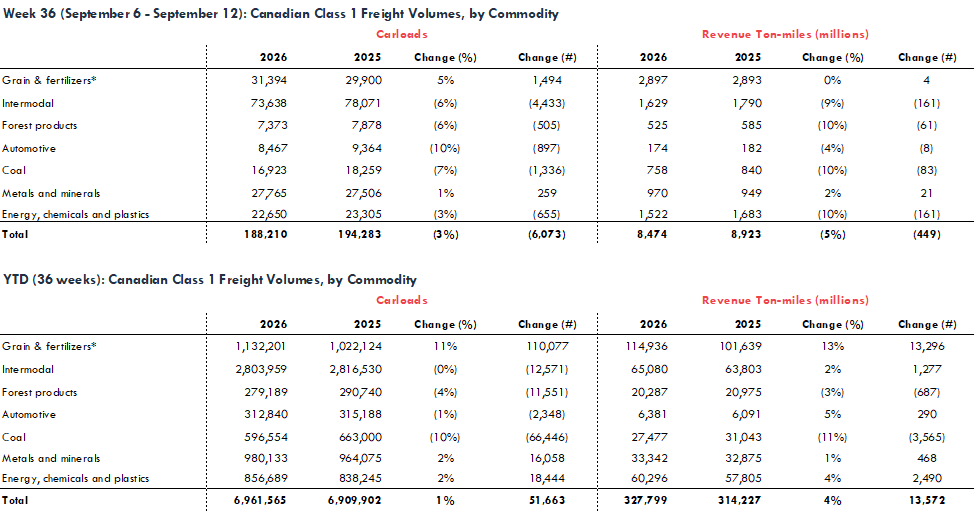
* Includes potash.
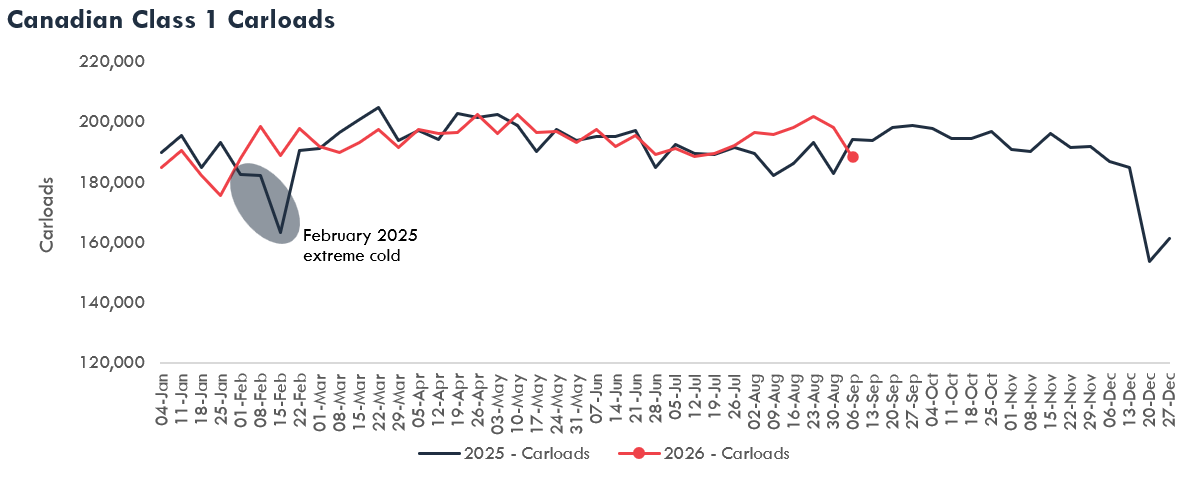
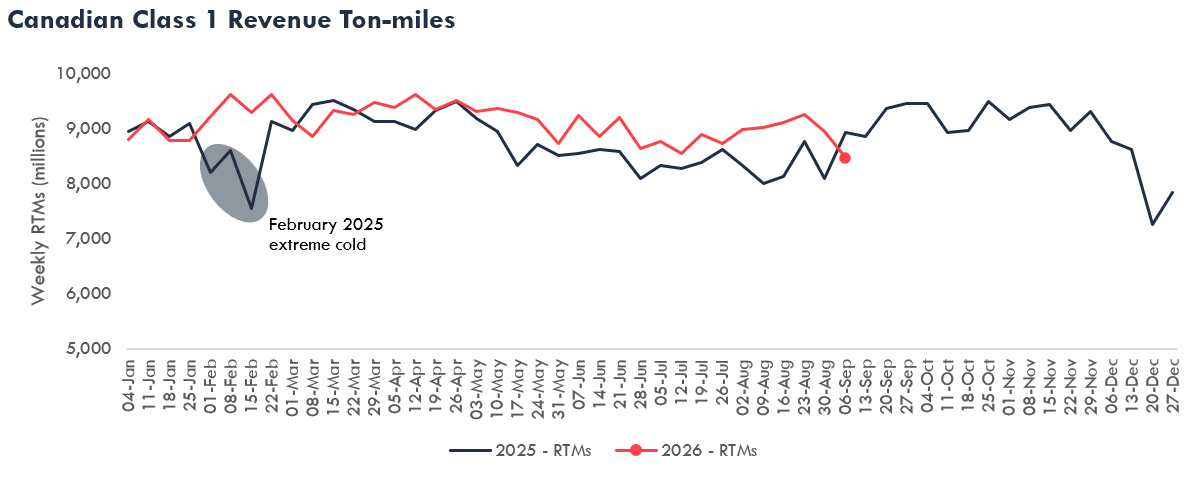
The dates indicate the first day of the week (e.g., “04-Jan” corresponds to the week of January 4 to 10). Canadian Class 1 data includes the network-wide operations of CN and CPKC.
Western Canadian Grain
In the 2025-2026 crop year (August 2025 – July 2026), CN and CPKC moved 64.0 million metric tonnes of Canadian grain and grain products – 15% higher than the previous 3-year average.
In week 6 (September 6 – September 12) of the 2026-2027 crop year, CN and CPKC moved more than 1.2 million metric tonnes of Canadian grain and grain products.
Crop year-to-date grain volumes (6 weeks)
7.0 million metric tonnes | +33% vs previous 3-year average
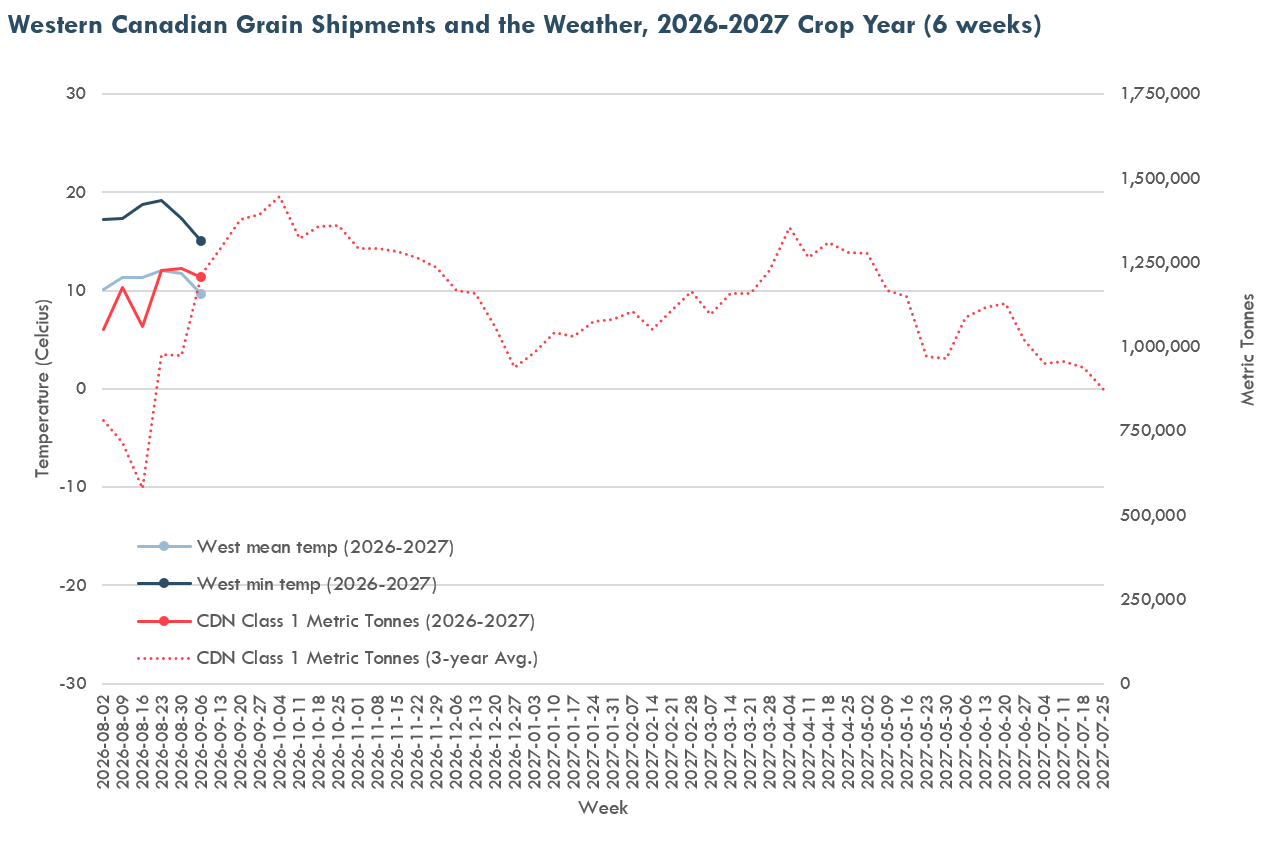
Notes: Data on Canadian grain shipments combine volumes from CN’s Western Canadian Grain Report and CPKC’s Canadian Grain Performance Scorecard. Weather data are from Environment and Natural Resources Canada. West min temp and West mean temp are calculated as the average temperature of cities throughout the Western Canadian Grain Supply Chain, including Thunder Bay, Regina, Saskatoon, Edmonton, Calgary, and Kamloops (Vancouver was omitted because temperatures there are not cold enough to cause significant supply chain disruptions).